
This is the final entry in a small series that initially started off as a post about recent updates. For this post, I’ll actually be focusing on the comics themselves again. Specifically, comic pages from earlier attempts to start this Mage Punk “webcomic” that I’ve wanted to make since middle school.
I’ve been working on the Mage Punk Archives for as long as I can remember. Long before it was even called Mage Punk. Before I even got the idea to post it online as a webcomic. From the moment I created my very first Sonic OC and dared to call him my Original. Continuing on through the rest of my life as a growing artist.
Then, I worked on it further as I fell more and more in love with storytelling in its various forms. And going on even further, as I adopted comics as the storytelling form I thought suited me the most. But even though I loved comics as a form of storytelling, I struggled to grasp it for myself. In fact, more times than I’m proud to admit, I’ve scrapped everything that I’ve worked on and started over entirely.

An Amalgam of Odd Comics Influences and Origins
Sprite Comics and Other Webcomics
It was long ago, before the modern miracle of handheld internet searches. I was a young Internet Explorer, seeking out gaming rumors, secrets, various hoaxes, fanart and fan games of my favorites.
It was all still relatively new at the time.
As I became a more experienced webling, I ventured down new rabbit holes. My love of fan games eventually led me to discover rom emulation. If you knew where to look, emulation was only just then becoming a little more accessible online. I learned of asset rips and their importance to fan gaming and the creation of sprite sheets. These interests would inevitably lead me to sprite comics.

In retrospect, sprite comics were a very peculiar comics medium. It was a form of visual media featuring artwork constructed from gathered elements, not far removed from digital collage. Sprite sheets were like little digital magazine pages you could cut and glue, over and over and over. Many sprite comics were usually some form of comedic parody gaming comics, though some occasionally took on more “serious” storylines. I must’ve spent countless hours reading sprite comic after sprite comic.

Initially, I thought that I wanted to start one of my own. Until it dawned on me that they weren’t really in line with my newer influences and blossoming skillset. Not to mention my actual technical limitations at the time. In actuality, I’d been pretty oblivious to how niche sprite comics actually were as far as gaming webcomics were concerned. Inevitably, I discovered more drawn non-gaming webcomics, as I ventured back out into a Wider World Web. Sprite comics soon faded into memory and I never really returned to them after that.
Regardless, sprites would always hold a special place in my heart as my initial ingress into the world of webcomics.

Japanese Media Bursts onto the Western Scene!
Around this the time, the presence of Japanese media was beginning to take hold in the west. Before this, it used to be far more niche and less prominent in pop culture than even video games were. 2003 saw Shonen Jump’s attempt to break into western print with a monthly edition of its weekly Japanese magazine. 4Kids was butchering anime dubs with relentless impunity and introducing kids to these new forms of animation. It felt like the Big Bang of Japanese media in the West. Everything that was influencing me, was already itself influenced by much of this media.
Inundated with so many new forms of storytelling and art, I couldn’t resist trying to weave all my influences together.

A comic of my own
Misunderstanding Comics Production
When first I got into webcomics, many of them were updating, one to three times a week on average. Fred Gallagher’s MegaTokyo was updating 2-3 a week on a somewhat loosely set schedule. Evan Dahm was wrapping up his surreal fantasy epic, Rice Boy; updated consistently Mondays, Wednesdays, and Fridays. Various other sprite and drawn webcomics that I was following seemed to be updating all the time. There were a few exceptions to these patterns; but they’d always felt like outliers to me. I hadn’t learned of update buffers; and hadn’t yet realized the burnout involved in keeping up with such a workload.
With manga, my misunderstanding of this output grew even worse. Shonen Jump released 16-20 (or more) page manga chapters weekly. Then, compared to western comics which credit most production roles on the cover, mangaka are singularly credited on their works. This led me to believe that most mangaka worked alone. At some point, I convince myself that most mangaka were these powerhouses of speed and skill. I had no idea at all that many of them actually had assistants helping them. My perspective of the work involved was deeply skewed by the rate of my consumption.
Clueless to everything, I attempted to start my own comic. with the goal of posting it online as a webcomic.
At first, I called it Mage.
Then, Fire Mage.


Comics Groundhog Day
There were many false starts and abandoned pages as I tried to find my “style”. Taking note from my favorite works, I tried anything I could to finish pages faster. Regardless, I struggled to keep the pace I thought I needed to achieve. Despite my best efforts, I could only average one page a week.
If even that much.


By the end of freshman year of high school, this was the first consistent set of pages that I’d completed. I though spiderwebs could save me the extra time it took to use a ruler for drawing straight panel borders. Additionally, I also thought they might also help give the comic this “old, archived” feel. But in the end, I wasn’t satisfied with the overall feel of it. I never even posted these online because I couldn’t strike a balance between drawing and uploading regularly.
So, I scrapped these pages and started over.


Comics Groundhog Day
Part 2
For my next consistent attempt, I followed the same sequence. However, this time I tried to keep a cleaner, tighter style than before. I thought it was going pretty well, if slow at first. Until midterms rolled around and I had to start thinking about college seriously. By page 7, I just couldn’t find the time to finish anymore pages. I’d also become really self-conscious of how much my style felt like it differed between the first and seventh pages. These never made it online either.
So, I scrapped these pages and started over.
Looking back, they weren’t really as disparate in style as I originally imagined them to be. Much of my later years in high school feel like a bit of a blur. My last year was especially busy, spent scrambling to resemble a student good enough to get into college. Things kept piling up and so the webcomic got put on the backburner for awhile.
Before I knew it, I was a freshman Illustration Major at The Art Institute of Fort Lauderdale.

ART3271C: Sequential Illustration
A Comics Art Course? In College??
I spent much of the next few years far too busy deconstructing myself and growing as an artist. For awhile, there was barely time to even really think of making a webcomic. Let alone any kind of comic pages, really. AiFL offered a Sequential Art course as an elective. Taught by one of my favorite professors at the school, Jon Hunt (Check out his work!) I signed up for it as soon as elective courses became available in my curriculum. It felt like the perfect opportunity, to hone my comics skills further and create Fire Mage as official school work. The overlap was too good to pass up.
We had three assignments for the entirety of this Sequential Art course.
In order, they were:
- “Daily Newspaper Comic Strips”
- “Comic in the Style of…”
and - “Five full color comic pages”


Intro Assignment: Newspaper Comic Strips
The first of our assignments for the sequential art course was to draw newspaper style comic strips. The goal of this assignment was to familiarize us with the process and challenges of producing newspaper comics. Or The Funny Papers, if you will. We had to draw either: 5 black and white daily strips; or 4 dailies and a full color Sunday strip.
We had roughly a week to complete them all.


Since Daily strips were essentially the analog predecessor to webcomics, this was a good opportunity to build-up some foundational skills. I wrote out a few gags with my characters and cranked the strips out in time for their deadline. The end results were pretty cool and I was fairly satisfied with the amount of output I achieved. However, I wasn’t super fond of the working pace required to finish these in the amount of time available.


Looking back, I wish I’d incorporated more influences from my favorite newspaper strips, like Peanuts and Garfield, into these comics. But I went in a different direction entirely, leaning more heavily into my manga influences. Instead, I went for something more akin to Japanese 4-koma comics. This works out great for a regular webcomic gag-strip; but didn’t really align well with my goals for Fire Mage.
The next assignment would pull me out of my comfort zone a little more.


Midterm: Comics in the Style of…
The next assignment in the class was to create 5 pages in the style of an artist of our choosing. We discussed our various influences at the time with Mr. Hunt individually. In turn, Hunt recommended other artists whose styles could be a good match ours. Among some of the artists he recommended for me, Mœbius and Mike Mignola were a pair that really stuck out.
By this point, I’d already learned that Mœbius was the kind of artist that was often your favorite’s favorite. Ironically, Mœbius was even one of Mignola’s earliest influences. One of my own major influences up to that point was Kazuki Takahashi’s Yu-Gi-Oh! Years prior in a monthly Shonen Jump, I learned that Mignola was one of Takahashi’s favorites.
It was like Six Degrees of Separation: Artist’s Influence Edition.

Around the time I first got into them, they’d both begun growing in popularity within their respective niches. Guillermo Del Toro’s Hellboy flick had come out recently-ish. The Yu-Gi-Oh! anime and card game was at a peak of popularity. At some point, their publishers organized an art trade between the two. It was so cool seeing them draw each other’s characters in their own respective styles. This project was a lot like that art trade, but the opposite.
For my comics assignment, I chose to make Fire Mage spin-off pages in the style of Mike Mignola.


Looking back, I think I could gleam which things I got right and wrong in my attempt to emulate Mignola. The second page where Sakura knocks the guards out was easily my favorite. I feel like it was also my most successful page of the set. Combining manga-like pacing with the statuesque stillness of Mike Mignola’s art, I think I’d struck a good balance between influences.
The Final: 5 Full-Color Comic Pages
Comics Groundhog Day Part 3
Right on the heels of midterms, we began work on our final assignment. A full-color, 5-page comic of any kind. Mr. Hunt had given us full freedom to draw any kind of comic we wanted. For mine, of course, I chose to work on Fire Mage again. Using my earlier attempts as a draft, I thought I could save myself some time on these new pages.
And so I redrew Fire Mage again.
For these Fire Mage pages, I tried working with ink wash instead of the detailed ink work I did previously. I was becoming more comfortable with watercolors and thought this could be an efficient way to apply my base shading. One of my main goals was to finish this set of pages in less time than the previous set. In my hubris, I’d also decided on overachieving by drawing an extra 2 pages for my final assignment. I was just so eager to show my love for comics with this assignment.
The 7 ink wash pages I created for my Sequential Art final:


Overwhelmed by my other school projects, I distinctly remember waiting until the very last minute to color and letter them. While I didn’t necessarily hate how it turned out, this was definitely my least favorite attempt starting Fire Mage.
There are just so many aspects of it that were rushed for the sake of meeting my deadline. Visually it was also really far removed from the original vision I had for my comic. By this point in time, I was slowly becoming aware that working fast simply wasn’t my strongest suit.
Overall, I think I learned a great deal about myself and the art of comics from this class.


The Rest of my Art Education
The Metamorphosis of an Art Style Begins
Throughout my years in college, I gained a lot of technical knowledge meant to improve the quality of my work. Skills and know-how valuable to the various fields I thought I wanted to break into after graduation. Unfortunately and unwittingly however, these new skills I was learning were also instilling my work with certain amount of rigidity. My work was stiff from adhering too closely to too many self-imposed “rules” I thought I needed to follow.


It was sometime shortly after the Sequential Art course when I encountered Katsuya Terada’s artwork, for the first time ever. I don’t recall where or when exactly, or what I may have been working on at the time. But I do remember finding this wicked illustration of Link’s final battle against Ganon.

This was one of a series he created for Nintendo’s Legend of Zelda: A Link to the Past. Katsuya Terada was yet another artist whose work was greatly inspired by Moebius.
Now, Mœbius’ art is indeed incredible. But for me, it was Terada’s artwork that acted as a catalyst to my art style changing. It inspired me trying to being more malleable when I draw and approach my work with some amount of levity.

I endeavoured to improve both the quality and speed of my work while also making it more my own.


I worked on Mage Punk when I could between assignments.


Between thinking I could possibly work on a for-print comic…
…and a webcomic at the same time.


The End
Most of these were actually made towards the end of my four years at Ai. Those of us graduating were tasked with compiling classwork from years past to meet the requirements for obtaining our degrees. I believe that we were given two semesters to gather our pieces. We were given time to do revisions and get them up to date with the rest of the portfolio pieces.
Illustration Graduates at AiFL were typically required to gather a required selection of their work into an on-demand printed book. The year that I graduated, my department decided to change things around a little. Specifically, we were given the option to collect the requirement work into a plain black binder portfolio. This allowed the printed book to be more geared towards our desired pursuits. I opted to make a Mage Punk/Orbyss Archives “Zine” as my main portfolio piece.

And Then College was Over
I drew a few more pages of the comic until I became employed full-time. These days, there aren’t enough free hours for me to keep up with any typical webcomic update schedule. So for a long while I stopped working on the comic altogether. I’m squeezing as much work out of every second that I’m not there; with whatever energy I can muster. This includes planning, writing, sketching and drawing. Before I got back to work on the site, I was posting fairly regularly to my Twitter and Instagram. Those posts took time to do as well.
Most of this post was written in separate sessions on my commutes to work.

“Shortcuts”
Even though I always wanted to present Mage Punk as a webcomic, I always worked on it like it would go to print eventually. This created a confusing mindset for me when working on the comic, where I had to work on a whole book, but I have to rush to finish every page. If I wanted to put out pages more frequently I took shortcuts at any point I could to be done with them. Even if I created a good buffer of finished pages, I’d still run into that same pitfall eventually. I wasn’t enjoying my project because of a pressure I applied on myself to finish it in a way I wasn’t necessarily comfortable with. I didn’t even get that much done in the end.


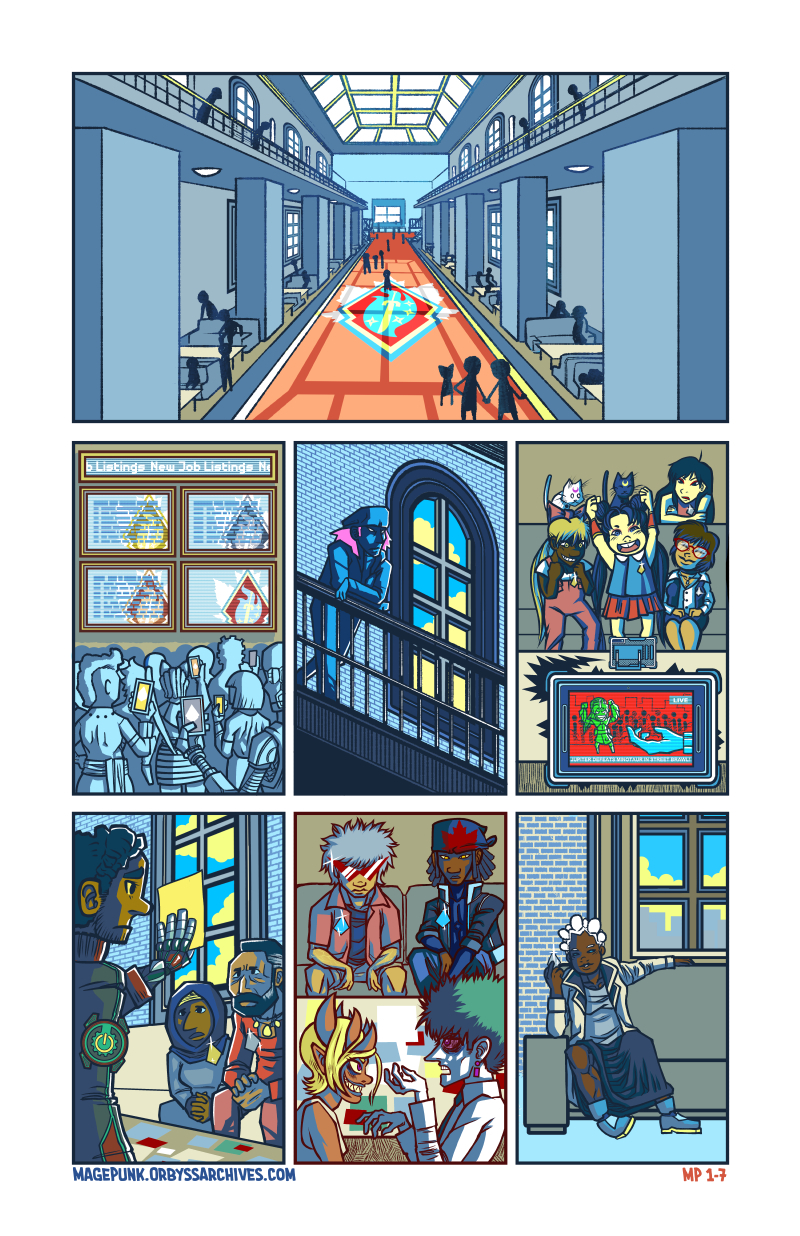
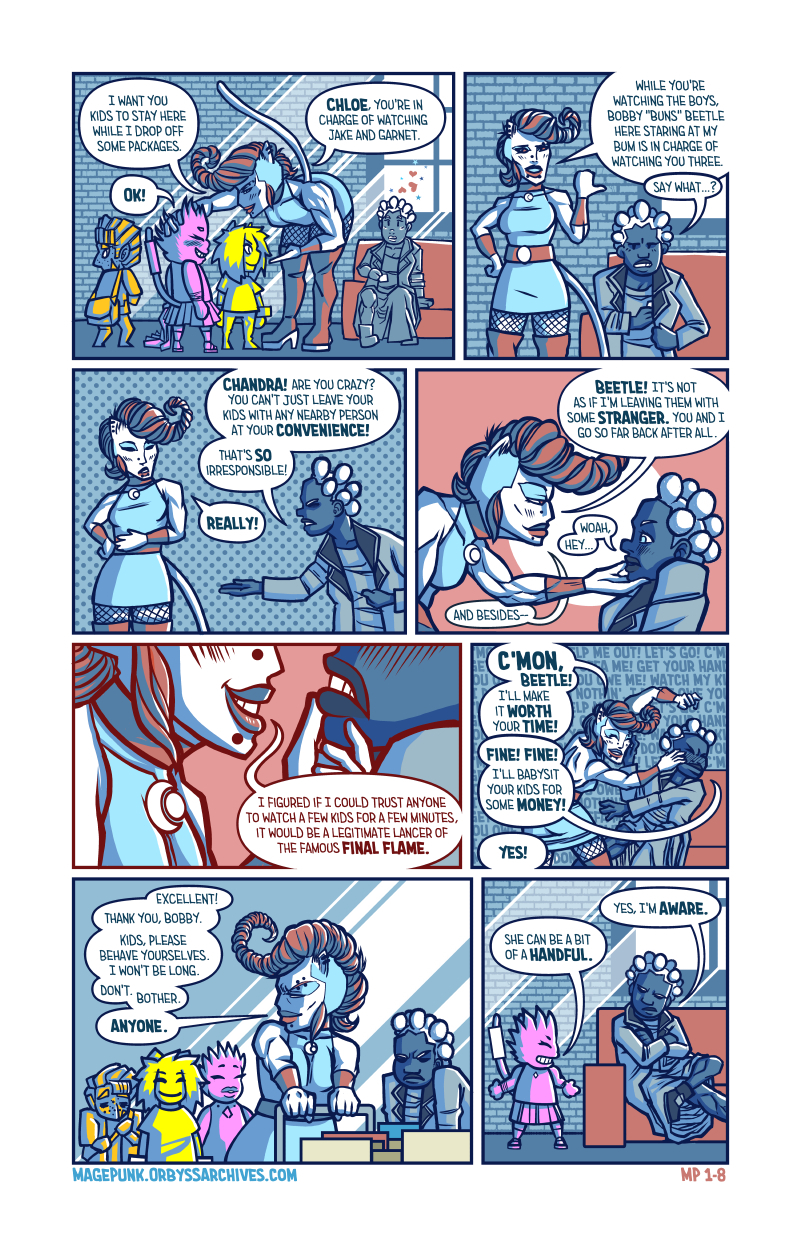


It’s important that I work on it at a pace that lets me show the best of my ability. I would love it if I could be properly finished with the pages before I post them but if I wait before it’s all good and done I’ll just never get around to posting anything, forever floating, aimlessly, throughout creative internet limbo.
Instead, if I have to work on my comic in piecemeal, I’ll just post it up in piecemeal. Mage Punk will still be presented as a webcomic but, until the end of the book is done, certain changes are still a possibility. Editing is an important part of producing any book and I’m going to make its presentation reflect that.
Cue Rhidiculous shouting “I told you so!” from some nearby bushes.
A Webcomic in Presentation Only?


Those Two Images are the Same Page
Instead of trying to finish things at breakneck speeds, I’m going to work on the comics at a more reasonable pace. I’ll try to work on it mainly Chapter to chapter instead of page to page like how a webcomic normally is done (buffers aside) This gives me the opportunity to take a step back and get a broader look at the story while still putting out content in enjoyable chunks.
It’s difficult for me to wrap my head around drawing a comic on a start-to-finish, page-by-page basis. While I was working on the later pages in the chapter I kept finding myself jumping around and making changes to previous pages to make some things more consistent with later parts of the story. Instead of working page-by-page, I was editing the chapter as a whole to try to strengthen the narrative I’m trying to tell.
To that end, I still want to present it on this site as a webcomic; if only in name and archive.


The Process
At the VERY longtime behest of my editor
I’ll be presenting the comic as a work in progress at various points in the following production stages.
- Writing
- I’ll post dialog excerpts here and there. Nothing that can spoil the story too much.
- This step will be kept largely behind the scenes.
- Thumbnails
- I do these on index cards in ballpoint pen to figure out the sequence of events that I most prefer.
- This is the step where I’m prone to overloading a page with information.
- First Drafts
- Full size roughs of the earlier thumbnails. This step helps me get a better sense of how crowded or unbalanced a page might be early on.
- This step also helps to prune out any strenuous scenes or dialog that could otherwise have their own pages.
- If it isn’t working visually at this point, it’s not going to work in the next step.
- Pencils
- This is where the real drawing happens. Drawings in this step are made by either digital or traditional means depending on when or where I’m working.
- Inking
- This step is exactly like the drawing step but in pen and ink. Despite my affinity for real pen and ink, I’ll mainly be working this step digitally.
- Color
- This step is wrought with indecision but it also one of the faster, more fun steps to do.
- Lettering
- I’ve removed the dialog from all the pages currently up, opting to keep that out until a chapter is completed; it’s the thing I’m likeliest to change the most frequently until the end.
- All lettering is currently done digitally but I’m considering the possibility of hand lettering.
- Drawing dialog can be quite fulfilling but it takes a lot of practice.
- Editing
- This part will be happening all throughout. Page re-orders, panel redraws, changes in dialog.
- Until the book is done.
Here We Are

I’ve already made some revisions to a handful of the pages that are already up; if you browse through the comics you can see the revisions noted in the comic descriptions. I’ll make blog posts for any major revisions or series of revisions that I do. I have a few ideas for some smaller projects that I can work on while I work on Mage Punk. Whether they be illustrations, stories, or even mini-comics like this silly thing down here.

Moving on
I might have also mentioned before that I have a few other drawings that I wanted to make for the site. In particular I have a neat idea for some social media icon illustrations. I wanna make something that takes advantage of what I’ve learned with using CSS. It’s nothing too fancy.
All that said, future posts will be a bit more brief than these last three were. I’d much rather write and post about the work itself, but I feel like I’ve hit a personal milestone and felt the need to ramble on about it a little.
Until next time,
Thanks for reading!
